

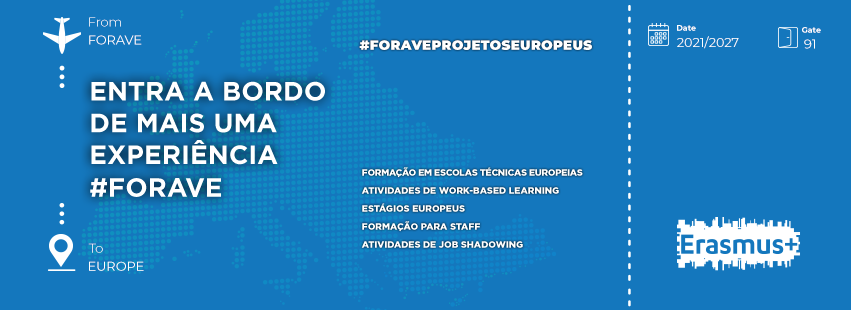
Formar jovens cada vez mais tolerantes e com uma maior consciência intercultural e europeia, permitir a cooperação e a partilha de práticas pedagógicas, a nível europeu, entre sistemas de ensino e de formação, e possibilitar o aperfeiçoamento de conhecimentos, competências e qualificações técnicas, facilitando a empregabilidade e a participação no mercado de trabalho europeu são os grandes objetivos que têm motivado a FORAVE a manter uma presença regular na Europa através da participação em projetos ERASMUS +.
A concretização destes objetivos só é possível pelo forte sentido de cooperação existente entre pessoas, instituições de ensino e formação e demais entidades da sociedade civil, que transcende fronteiras e se desenvolve a nível europeu desde 2003.
Ao longo de 16 anos, projetos com temas tão diferentes quanto a cultura e tradições europeias, a participação ativa da sociedade no ensino profissional, o racismo e as minorias na educação, o consumismo na adolescência, o abandono dos idosos, a melhoria da qualidade do ensino, o bullying, a utilização das TIC nas escolas, as expectativas para o futuro, a diversidade e multiculturalidade na Europa e a integração no mundo do trabalho têm sido trabalhados em cooperação com escolas, universidades, centros de formação e outras instituições ligadas ao ensino de 25 países europeus, mas também com o forte apoio por parte de parceiros, associações, empresas e autarquia locais, que, pretendendo acompanhar este espírito europeu, têm colaborado na concretização de trabalhos, reuniões, atividades e demonstrado disponibilidade e interesse pelos temas dos projetos.
Os projetos desenvolvidos pela FORAVE, quer como escola coordenadora, quer como escola parceira, possibilitam assim a realização de programas de intercâmbio, estágios e formação profissional, envolvendo os seus alunos e staff em trabalho colaborativo a nível europeu, permitindo o desenvolvimento de competências, no domínio do multilinguismo e do desenvolvimento profissional, pessoal e social, fazendo da FORAVE uma escola de dimensão Europeia, comprometida na participação de uma cidadania global com a consciência responsável da importância da multiculturalidade e do respeito pela diversidade.
SMARCO - Smart Communities Skills Development in Europe PROJECT ACRONYM: SMARCO ERASMUS + Blueprint European Action REFERENCE: Project No. 101186291 SMARCO strives to become a unique one-stop-shop for smart community skills focusing on three main objectives: Throughout the project implementation, the concept of smart communities’ understanding will be linked to increasing economic competitiveness, social well-being, resilience and sustainability, meanwhile ensuring a human-centred approach. In the initial phase, partners will conduct a needs assessment to identify the demand for smart communities’ skills as well as the already existing educational resources, projects, initiatives and best practices. An urgent short-term upskilling training will be further piloted with learners in 12 European countries, and additional train-the-trainer materials will be created and promoted towards European Digital Innovation Hubs. Throughout its journey, the project will provide smart communities’ engineers and public administrations’ staff with HE and VET training programmes which offer the most comprehensive and effective results. At least 400 learners will be engaged in the testing and evaluation phase, aimed at measuring the programme’s success and collecting feedback to improve learning outcomes. In the last phase, the focus will shift to the creation of a certification framework leveraging micro-credentials, as an acknowledgement of the specific acquired skills. By the end of the SMARCO Project, more than 200 decision-makers will be included in roundtable workshops, 10 VET courses will be developed, and a minimum of 100 learning resources will be collected and developed for HE curricula. In the last month of implementation, over 100 participants are expected to attend the final conference, where the consortium will present a retrospective of the project’s successfully achieved results and its impact on the smart communities experts, regarding the digital, green, resilience and sustainability skills. PROJECT START DATE: 1/02/2025 PROJECT END DATE: 31/01/2029 DURATION: 48 months COORDINATOR: European Digital SME Alliance, Belgium PROJECT WEBSITE: https://smarco.eu/ PROJECT LINKEDIN: https://www.linkedin.com/company/smarcoproject/ PROJECT INSTAGRAM:: https://www.instagram.com/smarcoproject PARTNERS Forave, Portugal Asociación de Técnicos de Informática, Spain BASSCOM, Bulgaria Cefriel, Italy Cluj IT Cluster, Romania Edutus Egyetem, Hungary Emphasys Centre, Cyprus ENoLL, Belgium Fondazione Piemonte Innova, Italy GAIA, Spain Hellenic Open University, Greece Lefkosia Municipality, Cyprus National College of Ireland, NCSR Demokritos, Greece Nordic Edge, Norway Österreichische Computer Gesellschaft, Austria Politeknika Txorierri , Spain Stichting Hogeschool Utrecht, Netherlands, Universidad de Alcalá, Spain University of Thessaly, Greece SIGNVET – GATEWAY TO EQUITY: ENGAGING DEAF STUDENTS INTO VET SIGNVET KA220-VET - Cooperation partnerships in vocational education and training REFERENCE: 2024-1-PT01-KA220-VET-000255551 Vocational training is rarely offered in national sign language which is a barrier preventing deaf students from proceeding studies. SignVET aims to empower VET Schools to provide course materials in national sign language, fostering inclusive learning environments for all. The objectives of the project are equip teachers to translate course material to national sign language, improve the access of the deaf to course materials and promote sign language skills in hearing students. We will design a methodology and create the tools to create semi-automatic sign language translations of digital content, we will train teachers to apply this methodology and use the tools, we will develop pilot courses, evaluate the results, review and refine all the process, while stimulating multiplier effects to escalate the use of the SignVET technology to deliver sign language translations of digital educational content in VET. At project completion, we will have courses translated into partners’ national sign languages, a methodology, the tools, and the trained staff to escalate this approach to the European VET eco-system. The SignVET technology will be presented and discussed in hands-on workshops. Interested teachers will be able to attend training sessions in-person or online. We will advocate for the integration of sign language accessibility measures into VET education policies and national guidelines. PROJECT START DATE: 01/10/2024 PROJECT END DATE: 30/09/2026 DURATION: 24 months COORDINATOR: Medidata.net - Sistemas de Informação Para Autarquias S.A. Towards networking and collaborative teaching materials in the field of industrial robotics ROBINTECH ERASMUS + KA 2 - KA220-VET - Cooperation partnerships in vocational education and training REFERENCE: 2024-1-EE01-KA220-VET-000248262 A CECIMO (European Association of Manufacturing Technologies) report highlighted that 67.7% of enterprises consider Robotics Specialists a highly significant professional profile for the near future. Most European enterprises consider technicians for automation and mechatronic systems the most wanted specialists in industries to operate mechatronic systems. There is a skills gap between expectations and what educational institutions can offer. Critics report that VET/university graduates are not immediately employable and need to undergo a long training process in companies before they can start performing tasks independently. From the educational institutions' point of view, there are two main needs to improve the situation in teaching automation and industrial robotics: » Industry collaboration and partnering with companies to update teachers’ skills and bring current expertise to education. » Available teaching resources through collaboration, as existing resources are limited. ROBINTECH will develop networking of partner VET schools and companies to share knowledge and increase the quality of automation and robotics training. We specifically aim to connect robotics and automation teachers with practitioners in industries to improve teachers' professional competencies and create and test new teaching materials in the fields of industrial robotics and automation and put them into practice to streamline training in VET education. Our main activities are: » teachers joint training and internship programmes in companies; » creating five sets of teaching materials on automation and robotics (EQF level 4); » piloting and evaluating new materials; » publishing and promoting the use of 25 new training modules for practical automation and industrial robotics training The main results of the project are: » active networking for skills development between participating VET schools and associated partners » 25 new and quality training materials to provide quality training in industrial robotics and automation » use of the results to streamline the quality of VET education in participating countries. PROJECT START DATE: 1 November 2024 PROJECT END DATE: 30 April 2027 DURATION: 30 months COORDINATOR: Tartu Vocational College (Estonia) PARTNERS Forave, Portugal Asociación de Técnicos de Informática, Spain BASSCOM, Bulgaria Cefriel, Italy Cluj IT Cluster, Romania Edutus Egyetem, Hungary Emphasys Centre, Cyprus ENoLL, Belgium Fondazione Piemonte Innova, Italy GAIA, Spain Hellenic Open University, Greece Lefkosia Municipality, Cyprus National College of Ireland, NCSR Demokritos, Greece Nordic Edge, Norway Österreichische Computer Gesellschaft, Austria Politeknika Txorierri , Spain Stichting Hogeschool Utrecht, Netherlands, Universidad de Alcalá, Spain University of Thessaly, Greece GENDERATE: GENDER MAINSTREAMING IN TECHNICAL VOCATIONAL EDUCATION AND TRAINING PROVIDERS GENDERATE KA220-VET - Cooperation partnerships in vocational education and training REFERENCE: 2023-1-PT01-KA220-VET-000160185 Even though progress has been made in higher education regarding the rates of gender participation, still in Technical and Vocational Education and Training female representation is lower in comparison to general education programmes. The European Union is constantly taking upon initiatives in an effort to promote a vocational education and learning that not only adapts swiftly to labour market needs providing quality learning opportunities for young people and adults but also a vocational education that promotes equality of opportunities that are inclusive and accessible for all, such as the Gender Equality Strategy 2020-2025 that highlights and promotes the importance of a gender balanced vocational education. While TVET offers the potential to bolster the participation of women in the labour market, this potential is not always well understood and capitalised on. Still there is a persistence of stereotypes, male and female traditionally dominated professions, segregation and gender gaps. However, achieving simply a higher representation of female students in TVET is not the hardest challenge. Achieving gender equality in the TVET sector, like all sectors, goes beyond filling the necessary quota; rather, it is truly achieved through transformation at institutional and personal level and gender mainstreaming. As a consortium, we aspire to support the efforts of achieving gender equality in TVET, a gender equality that not only aims to empower females to join technical and vocational education but also to support the efforts of organisations for gender mainstreaming. GENDERATE will facilitate gender mainstreaming at institutional structural and management level through strategic planning and training of higher management levels in a TVET institution and will introduce and develop programs that are focus not only in simply acquiring technical skills for students but programs, in that case female mentoring programs, that operate as support mechanisms that empower women in TVET by building deeper personal connections. Finally, GENDERATE will actively include females in the process and communicate the message of gender equality in TVET, dismantle stereotypes, address the challenges and fight false perceptions through outreach activities and awareness campaigns. Objectives of the project: »Fostering the adoption of gender mainstreaming strategies by Technical and Vocational Education and training Institutions. » Support the TVET institutional transformation by building capacity in the TVET sector at an institutional and individual level. »Implementation of new and more relevant teaching and learning approaches that have female students in the centre of the educational process »Empowering female students to continue their education in technical professions. » Enhancing the attractiveness and social image of TVET institutions through actions targeting various groups: students, parents, enterprises, decision-makers, and the general public. »Raising awareness about the gender disparities in the TVET sector and the importance of creating a gender-responsive education by implementing policies, actions and programmes that effectively support female individuals. » Communicate the project with significant stakeholders and policy makers to sensitise them towards the importance of gender mainstreaming in TVET. » Develop high quality materials, transferable to other sectors, thus ensuring the sustainability of the GENDERATE project. Project results: »A gender-responsive strategic plan constantly updated throughout the project. »A training course on gender responsive and inclusive TVET sector targeting individuals in decision-making positions with active role and influence in structural changes of the TVET institution. » Development and implementation of a mentoring programme involving female mentors and female mentees. » Development of a guidebook to assist the mentors during the mentoring sessions with the students » Training webinars for the mentors involved in the mentoring programme. » A series of actions that will educate and sensitise on the equal participation of all genders in acquiring technical and vocational skills, thus enhancing the overall social image of the TVET sector (info days, job fairs and open career days, conferences, local events and a digital awareness campaign (a podcast series and an animated series)). PROJECT START DATE: 01/11/2023 PROJECT END DATE: 31/10/2025 DURATION: 24 months COORDINATOR: FORAVE - Associação para a Educação Profissional do Vale do Ave (Portugal) Website: https://genderateproject.eu/ Facebook: facebook.com/genderate Instagram: @genderate_euproject LinkedIn: genderate-euproject YouTube: @GENDERATEEUPROJECT PARTNERS Politeknika Ikastegia Txorierri Elazığ Marmara Vocational and Technical Anatolian High School STEM Education: from school to a tech world ERASMUS + KA 2 - Cooperation among organisations and institutions / KA210 – Small-scale Partnerships in school education REFERENCE: 2021-1-PT01-KA210-SCH-00048189 STEM skills are an increasingly important part of basic literacy in today’s knowledge-oriented society. Europe needs more scientists and science-aware citizens but it continues to face a low number of students interested in studying or pursuing a career in the STEM field. According to an OECD research, pupils see STEM as boring, not related with real life and hard to study. And, as the same research shows, teachers are the main factor which influences choosing STEM related professions. Europe’s future heavily relies on technology and related sciences. As a result, the next decades will witness an increasing demand for people with relevant skills to meet this challenge. In the field of education, Europe is therefore facing the urgent need of attracting enough people interested in science (S), technology (T), engineering (E) and mathematics (M) related fields of study and subsequent professions. The STEM approach for learning and teaching encourages the blending of knowledge that is required in the real world and natural curiosity. It promotes cross-cutting, ‘transversal’ skills such as digital skills, critical thinking, problem-solving, management, team work and entrepreneurship. It also promotes cooperation with non-academic partners and responds to economic, environmental, political and social challenges. With our project, the project partners will cooperate with high education institutions and representatives from the world of work to promote students´ interest and excellence in science, technology, engineering and mathematics. Partners will develop and implement teaching materials based on real experience, practical knowledge and schools’ best practices. PROJECT START DATE: 1 April 2022 PROJECT END DATE: 1 April 2024 DURATION: 24 months COORDINATOR: FORAVE PROJECT MEETINGS: Portugal, Estonia MOBILITIES: 14 PROJECT WEBSITE: stemeducation.pt/ PARTNERS Career Pathways ERASMUS + KA 220 – Cooperation partnerships in vocational education and training REFERENCE: 2020-1-PT01-KA226-VET-094771 Our partnership in vocational education and training aims to support VET institutions on how new skill needs can best be addressed. The advancement of digital technologies, including artificial intelligence, machine learning, automation and new forms of work and work organisation, has wide-ranging economic and societal implications now and in the future. At the same time, the shift towards more sustainable and green economies is reshaping labour market demand and supply. PROJECT START DATE: 1 November 2021 PROJECT END DATE: 1 September 2024 DURATION: 34 months COORDINATOR: Associação Universidade-Empresa para o Desenvolvimento - TecMinho PROJECT MEETINGS: Portugal, Spain, Greece STAFF MOBILITIES: 8 PROJECT WEBSITE: career-pathways.eu Hybrid Learning Lab for Industry 4.0 Mechatronics PROJECT ACRONYM: HLLi4.0 ERASMUS + KA 220 – Cooperation partnerships in vocational education and training REFERENCE: 2020-1-PT01-KA226-VET-094771 The project is carried out by five schools and organisations from Estonia, Portugal, Poland and Croatia. The aim of the project is to adjust vocational education in the field of mechatronics with the labour market in the context of the growing Industry 4.0. Rapid technological and digital progress requires the acquisition of new skills and competencies to work in such an environment. The project seeks to develop key competencies needed for students’ active participation in the labour market after graduation. There are several categories of project activities that will be carried out: PROJECT START DATE: 1 November 2021 PROJECT END DATE: 31 October 2023 DURATION: 24 months COORDINATOR: Electromechanical School Varaždin PROJECT MEETINGS: Croatia, Poland, Portugal, Estonia STAFF MOBILITIES: 10 PROJECT WEBSITE: ess.hr We-R-Open: An educational approach for digital upskilling of Teaching, Managerial and Administrative staff of VET Schools ERASMUS + KA 2 - Cooperation for innovation and the exchange of good practices / KA226 - Partnerships for Digital Education Readiness REFERENCE: 2020-1-PT01-KA226-VET-094771 The central aim of this project is to contribute to the digital transformation of the whole range of VET services to cope with unprecedented needs created by the COVID-19 pandemic, at the same time boosting the entrance of VET institutions and staff in the digital era. We-R-Open will achieve this aim by developing an online set of learning resources to support the digital transformation of VET courses as well as a training course for VET administrative/support and back office staff to help them developing digital skills for communicating with students, companies hosting apprentices, training staff, parents, for supporting e-learning process and for undertaking from distance their everyday work. The project aims at developing these skills through joining deep knowledge and expertise on both the VET sector needs and on the development of digital learning and tools of six institutions coming from five European countries. More specifically, “We-R-Open: An educational approach for digital upskilling of Teaching, Managerial and Administrative staff of VET Schools” will produce two core intellectual outputs an “Online VET classrooms” online Toolkit and a ”We-R-Open” Course for Administrative/Support and Back Office Staff. The project goals are: PROJECT START DATE: 1 March 2021 PROJECT END DATE: 31 December 2022 DURATION: 22 months COORDINATOR: FORAVE PROJECT MEETINGS: Portugal, Spain, Greece STAFF MOBILITIES: 4 PROJECT WEBSITE: https://weropen-project.eu/ SHAPE the future teacher PROJECT ACRONYM: SHAPE ERASMUS + KA 2 - Cooperation for innovation and the exchange of good practices / KA201 - Strategic Partnerships for school education REFERENCE: 2020-1-EL01-KA201-079206 For the last decades, most educational professionals have agreed that Information and Communication Technology (ICT) has a positive impact on learners' motivation, achievement, transversal, and higher order thinking skills. At the same time, a growing variety of technical and cognitive skills, known as ‘digital literacy’, is required from the younger generations to perform tasks and solve problems in digital environments and in everyday life. Education needs to comply with the new employability demands and prepare high-skilled future citizens. The “SHAPE the future teacher” project will focus on the need for incorporating digital literacy into the school curriculum through learning scenarios developed, evaluated and disseminated by all the partners in a bilingual way. It will be applied into a wide and diverse range of fields of studies highly connected with increasing the employability chances of the future citizens while investing in European citizenship. More specifically it will be applied in STEM, Entrepreneurship, Cultural Heritage, Citizenship and Environmental Education. The basis of our cooperation is set on the experimentation with innovative technology and the integration of our outcomes into school curriculum, teaching and learning processes. We will focus on creating 3 learning scenarios per school for the above educational fields, applied in a bilingual system. Through carefully selected activities we will motivate our students to learn in a different way, certainly more active. Each scenario will include detailed steps for certain educational purposes and specific learning objectives and will be supported by relevant notes about the main learning theories (behaviour, constructivism and social development theories) and the models of integrating the ICT tools into the learning process. The final collection of the learning scenarios will be available for educational use through an online resource platform, called “Scenario resource platform”. Finally, we will create a network of educational organizations across Europe with which we have working ties and share the learning scenarios with them. It will be an online resource platform with shared resource material with possibilities for further development. The objectives of the project are: PROJECT START DATE: 31 December 2020 PROJECT END DATE: 30 December 2022 DURATION: 24 months COORDINATOR: Scientific Association for the Promotion of Lifelong Learning PROJECT MEETINGS: Greece, France, Italy, Spain STAFF MOBILITIES: 18 PROJECT WEBSITE: https://www.eedive.gr/ka2shape/
ERASMUS + KA1
ERASMUS +SMARCO - Smart Communities Skills Development in Europe
PROJECT TITLE
TYPE OF PROJECT
PROJECT SUMMARY
ERASMUS + KA2 - SIGNVET
PROJECT TITLE
PROJECT ACRONYM
TYPE OF PROJECT
PROJECT SUMMARY
ERASMUS + KA2 - Robintech
PROJECT TITLE
PROJECT ACRONYM
TYPE OF PROJECT
PROJECT SUMMARY
ERASMUS + KA2 - GENDERATE
PROJECT TITLE
PROJECT ACRONYM
TYPE OF PROJECT
PROJECT SUMMARY

ERASMUS + KA2 - STEM Education: from school to a tech world
PROJECT TITLE
TYPE OF PROJECT
PROJECT SUMMARY
ERASMUS + KA2 - Career Pathways
PROJECT TITLE
TYPE OF PROJECT
PROJECT SUMMARY
ERASMUS + KA2 - Hybrid Learning Lab for Industry 4.0 Mechatronics
PROJECT TITLE
TYPE OF PROJECT
PROJECT SUMMARY
ERASMUS + KA2 - We R Open
PROJECT TITLE
TYPE OF PROJECT
PROJECT SUMMARY
ERASMUS + KA2 - SHAPE the future teacher
PROJECT TITLE
TYPE OF PROJECT
PROJECT SUMMARY
The Future of the Jobs vs the Jobs of the Future PROJECT ACRONYM: --- ERASMUS + KA 2 - Cooperation for innovation and the exchange of good practices/ KA202 - Strategic Partnerships for vocational education and training REFERENCE: 2019-1-HU01-KA202_06896 Schools taking part in the project have to cope with the same problems, a challenging economic situation. In vocational training, some students are under motivated, they drop out school too early, and they do not have any plans for the future. In our changing world, the labour market requires more-educated workers with up-to-date knowledge. New professions are required in many fields of economy, and schools have to follow the new trends to follow the requirements and needs of companies, or employers. Most organisations are facing the same challenge of demand for high-level qualifications in EU, so we try to renew the vocational education according to the needs of the domestic and international job market. This should answer the demand of high-qualified teachers and professionals at schools and other institutions to provide enough well qualified workers. The main aim of vocational education is to prepare students for the future, as we want to give them such education and professional knowledge that will help them to be successful both in the national and international labour market. At the end of the project, we will compile a book with good practices which will be published in paper form and online both in English and in the mother language of the participant countries. The content of this publication will be the good practices and methods collected during the project implementation including the following topics: PROJECT START DATE: 1 September 2019 PROJECT END DATE: 31 August 2021 DURATION: 24 months COORDINATOR: Nyíregyházi Szakképzési Centrum (Hungary) PROJECT MEETINGS: Hungary, Greece, Norway, Portugal, Italy, Spain STAFF MOBILITIES: -- PROJECT WEBSITE: https://futurevsjobs.weebly.com/
ERASMUS + KA2 - The Future of the Jobs vs the Jobs of the Future
PROJECT TITLE
TYPE OF PROJECT
PROJECT SUMMARY
ERASMUS + KA2 - Build a bridge between European Nations
TYPE OF PROJECT
ERASMUS + KA 2 Cooperation for innovation and the exchange of good practices / KA229 - School Exchange Partnerships
ERASMUS + KA2 - Every child matters – refugees and immigrants in education
TYPE OF PROJECT
ERASMUS + KA 2 - Cooperation for innovation and the exchange of good practices / Strategic Partnerships for Schools Only

ERASMUS + KA2 - Roadmap to building a caring and respectful school community
PROJECT TITLE
Roadmap to building a caring and respectful school community (anti-bullying strategies)

TYPE OF PROJECT
ERASMUS + KA 2 - Cooperation for innovation and the exchange of good practices / KA229 - School Exchange Partnerships)
ERASMUS + KA2 - E-Treasure – my lovely Europe
PROJECT TITLE
TYPE OF PROJECT
ERASMUS + KA2 - Cooperation for innovation and the exchange of good practices / Strategic Partnerships for Schools Only
ERASMUS + KA2 - ECWORK – ECVET for work-based learning
PROJECT TITLE
ECWORK – ECVET for work-based learning
TYPE OF PROJECT
ERASMUS + KA2 - Cooperation for innovation and the exchange of good practices / Strategic Partnerships for vocational education and training
ERASMUS + KA2 - Teachnology in Education
PROJECT TITLE
TYPE OF PROJECT
ERASMUS + KA2 - Cooperation for innovation and the exchange of good practices / Strategic Partnerships for Schools Only
COMENIUS
GRUNDTVIG
LEONARDO DA VINCI
VET ASSOCIATIONS



Cursos Profissionais

[25/26] Newsletter - 3º Período
FORAVE | Construir o Futuro com Inovação, Conhecimento e Compromisso
Chegamos ao final de mais um ano letivo com um profundo sentimento de realização.
35 ANOS
